Every custom bandana decision eventually comes back to one question that gets asked too late: what is the fabric? People pick a size, settle on a print, approve a color, and only then discover that the cloth they chose fights the print method or feels wrong against the skin. Fabric is not a detail to confirm at the end. It sets how the ink sits, how the color survives washing, how the bandana feels around a neck or a dog’s collar, and how much a bulk run costs. This is a look under the hood at the materials themselves, so you can choose the cloth first and let everything else follow.
The three families, and what separates them
Almost every bandana is cut from one of three fabric families. Cotton is the classic: soft, breathable, gentle on skin, and hypoallergenic, which is why it dominates fashion and retail bandanas and anything worn against the face. Its weaknesses are practical rather than cosmetic. Cotton is prone to shrinking in high heat unless it has been pre-treated, it wrinkles easily, and as a raw material it costs more, which shows up in the per-unit price of a large order. Polyester is the opposite profile. It resists stretching and shrinking, holds up to repeated washing, and is generally cheaper to produce, which makes it the budget-friendly choice for big promotional runs. The catch is feel: polyester can seem less soft and can feel a little sticky against sweaty skin, so it wins on durability and loses on comfort. Poly-cotton blends exist to split that difference, pairing cotton’s hand with polyester’s resilience and lower cost.
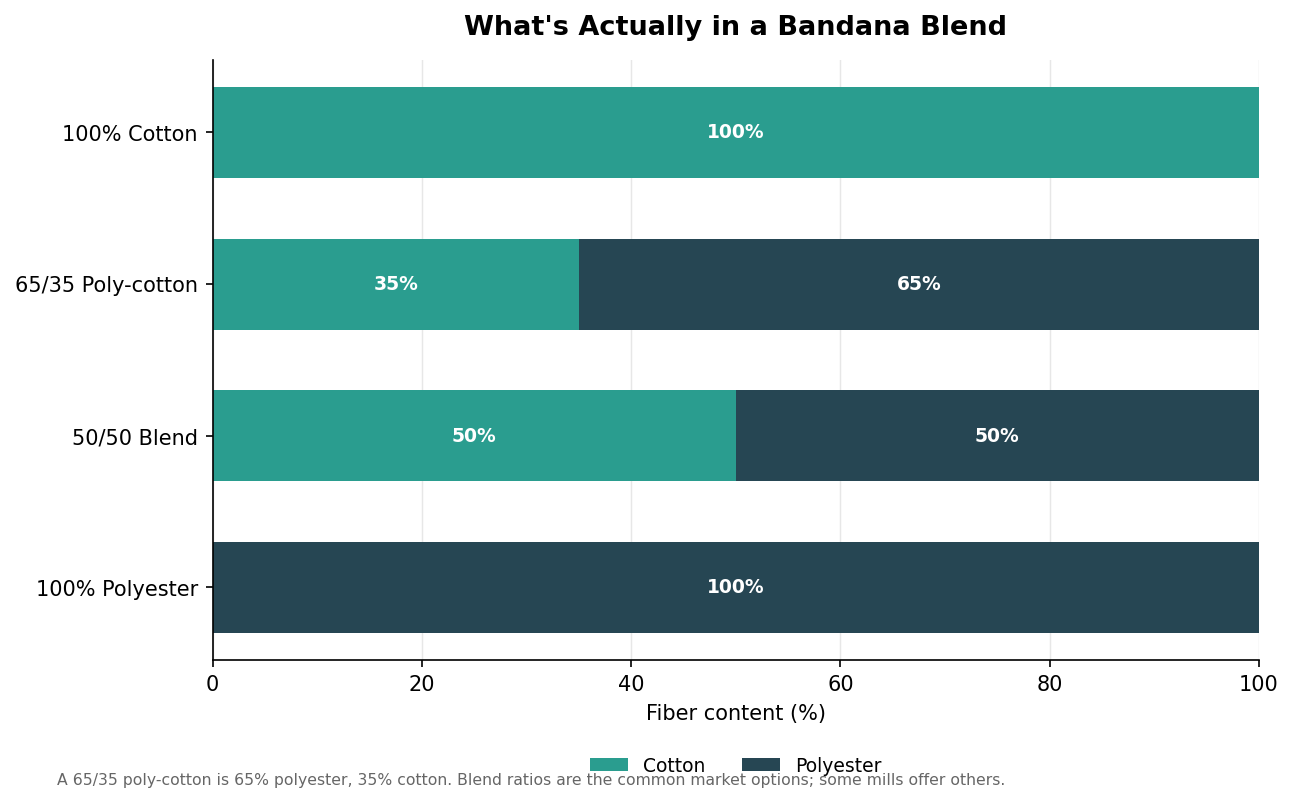
One point on that chart trips up a lot of first-time buyers. A “65/35 poly-cotton” is 65 percent polyester and 35 percent cotton, not the other way around; the polyester share is listed first. If you want a blend that leans toward cotton’s softness, you are looking for something closer to 50/50 or a cotton-majority mix, and it is worth stating the exact ratio you want rather than trusting a vague “cotton blend” label.
Weave and weight change the character within cotton
Cotton is not one thing. The weave decides whether a cotton bandana feels crisp and light or thick and rugged. Cotton poplin is smooth, lightweight, and tightly woven, which makes it a strong surface for detailed prints where fine lines and small text need to hold. Cotton twill uses a diagonal weave that is thicker, heavier, and more durable, trading some print sharpness for a substantial, hard-wearing feel. Fabric weight follows the same logic. Lighter bandanas, in the indicative range of roughly 100 to 130 grams per square meter, drape softly and tie easily, which suits neckwear and giveaways; heavier constructions climbing toward 150 to 180 grams per square meter feel more premium and survive rougher use, at the cost of a stiffer knot. Treat those weight figures as general guidance rather than a fixed standard, because mills vary, but the direction is dependable: lighter for drape and detail, heavier for durability and a premium hand.
The print method should match the cloth
This is where choosing fabric first pays off, because the two big print methods each prefer a different material. Screen printing lays opaque ink onto the surface and is at home on cotton, where the fiber accepts natural dyes and pigment inks well; it is excellent for bold, limited-color designs and holds up on a natural fabric. Dye sublimation works by turning dye into gas that bonds into polyester fiber, which means it needs polyester to work and rewards you with vivid, full-color, edge-to-edge designs and photographic detail that screen printing cannot easily match. The practical consequence is simple: if your artwork is one or two punchy colors and you want a natural cotton feel, screen printing on cotton is the natural pairing; if your design is full-color, gradient-heavy, or photographic, you are choosing polyester so sublimation can do its job. Trying to force a full-bleed rainbow onto cotton, or expecting a soft natural hand from a sublimated polyester, is how orders end up disappointing.
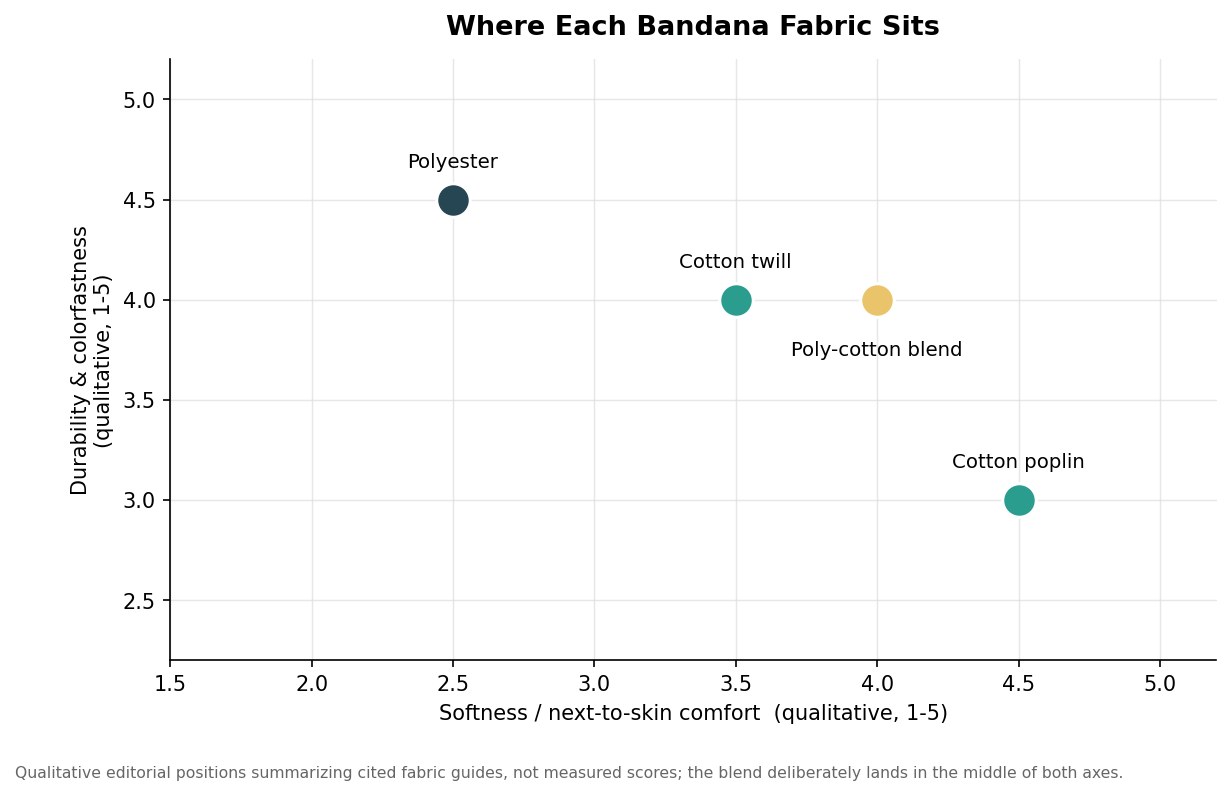
The positioning map above is a qualitative summary rather than a lab result, but it captures the trade every buyer is really making. Cotton poplin gives you the softest hand and the best canvas for fine screen prints while asking for care in the wash. Polyester anchors the durable, colorfast corner and pairs with sublimation for vivid graphics. The poly-cotton blend deliberately lands in the middle of both axes, which is exactly why it is the safe default when you cannot fully predict how a bandana will be used or laundered.
The finish and the care label are part of the spec
Two smaller fabric-linked details decide how a bandana ages. The edge finish is the first: a bandana can be left with a simple printed or overlocked edge for economy, or given a folded and stitched hem for a cleaner, longer-lasting border. A stitched hem resists fraying through repeated washing and reads as higher quality in the hand, which matters for retail and keepsake pieces more than for a one-day giveaway. The second is care behavior, which flows directly from the fabric choice. Cotton wants a cooler wash and benefits from pre-shrinking so it does not tighten up after the first laundering, while polyester and blends tolerate repeated washing with little change. If your bandanas will be washed often, as workwear or pet accessories are, that colorfastness and shrink resistance is a real argument for leaning toward polyester or a blend rather than pure cotton.
Choosing the cloth, then the rest
Put the material decision first and the order falls into place. Decide the feel and use: skin-contact comfort and a natural look point to cotton, heavy washing and vivid full-color graphics point to polyester, and an unpredictable mix of both points to a poly-cotton blend. Within cotton, pick poplin for fine prints and light drape or twill for a rugged, premium weight. Let that fabric choose the print method rather than the reverse, add a stitched hem where longevity matters, and set your care expectations to match the fiber. Do that, and the size, color, and artwork you settle on afterward will land on a cloth that actually supports them, instead of quietly working against the bandana you had in mind.