Category: Uncategorized

  • Print-Ready Artwork for Custom Bandanas: Safe Zones, Bleed, and Color Setup

    Print-Ready Artwork for Custom Bandanas: Safe Zones, Bleed, and Color Setup

    The single decision that most often separates a clean custom bandana from a disappointing one is not the fabric or the print method. It is how the artwork file was built before it ever reached the press. A logo that looks crisp on a screen can end up trimmed by the hem, muddied by a bad color build, or stretched a quarter inch off-square once the fabric relaxes. Getting the file right is the cheapest quality control you have, and it takes about fifteen minutes of planning.

    Start with the finished size, then design smaller

    A bandana’s cut size is not its printable size. The most common finished square is 22 by 22 inches, with an 18-inch size used for pets and smaller giveaways and a 27-inch size favored for headwraps and larger apparel looks. Whatever the cut dimension, the fabric loses usable area at every edge to the rolled or stitched hem, and it loses a bit more to the fold lines that a folded bandana naturally creates. A practical rule is to keep critical elements — text, a logo mark, a registered trademark — inside a safe margin of roughly 0.6 to 0.8 inches (about 1.5 to 2 cm) from each edge. On a 22-inch square that leaves a usable design zone near 20.5 inches; on a 27-inch square, about 25.5 inches. The chart below shows how much the safe margin subtracts across common sizes.
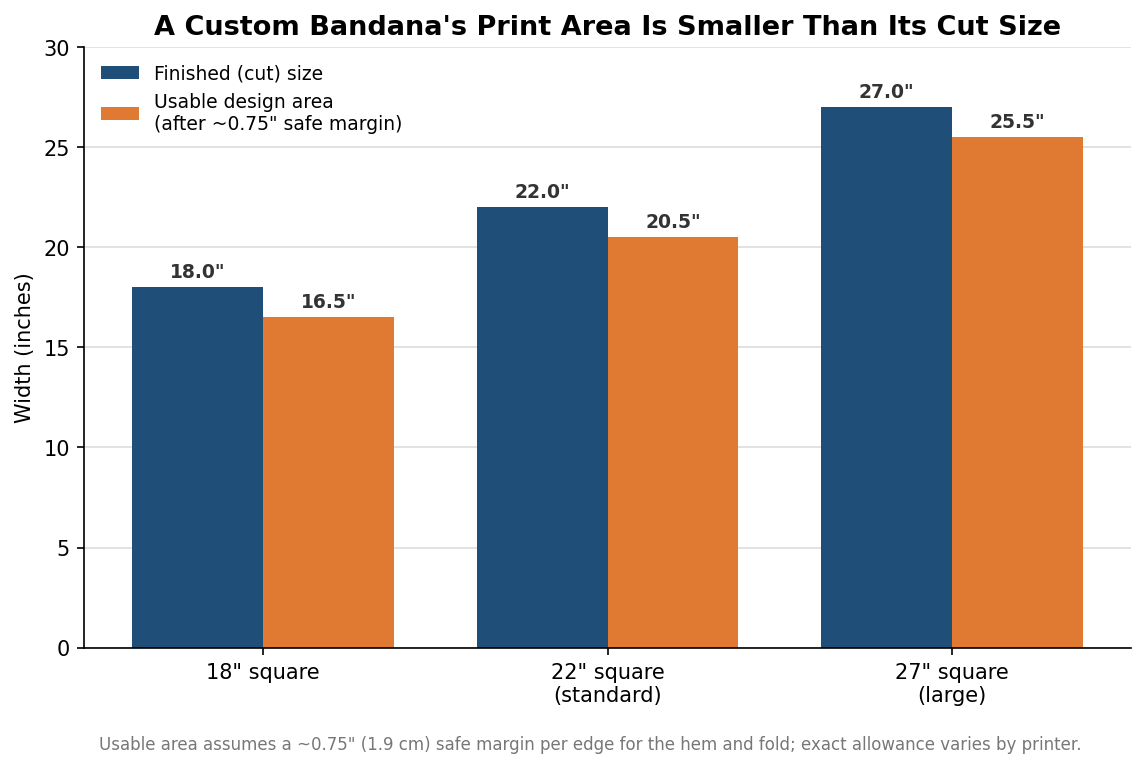
    Grouped bar chart comparing finished bandana size to usable design area after a safe margin for 18, 22, and 27 inch squares
    On a standard 22-inch bandana, the usable design area is closer to 20.5 inches once you allow a safe margin at every edge.

    Screen printers reinforce this at the shop level by sizing the screen frame two to three centimeters smaller than the fabric, which is another way of saying the design simply cannot run to the raw edge on a spot-color job. If your layout depends on ink reaching the very corner, that is a signal you are heading toward an edge-to-edge process rather than a bordered one.

    Decide between an edge-to-edge and a bordered layout

    Bandana designs fall into two families, and the file has to be built for one or the other from the start. A bordered layout places the artwork inside a defined field with unprinted fabric around the perimeter. It is the more forgiving option: small shifts during printing hide inside the margin, registration is easier, and a single or two-color screen job handles it cleanly. An edge-to-edge layout, where color and pattern run all the way to the cut line, has no margin to hide behind, so it needs bleed — extra artwork extending past the trim line so that no unprinted sliver appears if the cut wanders slightly. Classic paisley bandanas are edge-to-edge by nature, and reproducing that all-over coverage in a custom design almost always pushes the job toward dye sublimation or an all-over print method rather than a placed screen print. If you want the traditional full-coverage look, build the file with bleed and expect a full-color process; if you want a logo on plain ground, a bordered spot-color file is simpler and usually cheaper.

    Match the print method to the art, not the other way around

    The artwork itself tells you which press it belongs on. Screen printing lays down solid spot colors and is the workhorse for logos, wordmarks, and simple graphics. It reproduces Pantone (PMS) values accurately, holds up to washing, and gets more economical as quantities climb, but each color is a separate screen and a separate registration step, so a design’s color count directly drives setup and price. Keep spot-color art to a small, deliberate palette — two or three colors covers most brand marks — and specify exact PMS numbers rather than leaving the printer to guess from an RGB file. Medium-weight bandanas are commonly printed through a mesh in the 120 to 150 threads-per-inch range, which balances ink coverage against fine detail.

    Dye sublimation, by contrast, is the route for photographic images, gradients, tight color blends, and any edge-to-edge coverage. It prints full color without per-color screen charges, which makes it the sensible choice when a design has more than a handful of colors or a continuous-tone background. The tradeoff is that sublimation bonds to polyester, so a cotton-feel bandana and a photographic full-color print are usually competing goals. Knowing which of these two processes your art requires before you finalize the file prevents the most common back-and-forth with a printer.

    Send files a printer can actually use

    Vector files are the ideal deliverable because they scale to any bandana size without losing sharpness. Supply .ai, .eps, or a vector .pdf whenever the art is a logo or line-based graphic, and convert all fonts to outlines so the shop does not need your typefaces. When the design is photographic and destined for sublimation, high-resolution raster art works, but build it at 300 DPI at the final print dimension — not at thumbnail size scaled up. Include your Pantone references in the file or in a note, flag any element that must match a brand standard exactly, and separate front and back art clearly if you are ordering double-sided. A reputable printer reviews every file before it runs, but that review catches problems faster when the file arrives correctly built.

    Build in shrinkage and always approve a proof

    Fabric moves. Cotton and cotton blends can shrink noticeably after their first wash, and pre-production allowances commonly run around 3 percent for cotton, 2 percent for silk, and about 1 percent for synthetics. That movement is exactly why the safe margin matters: a design sized to the raw edge on a cotton bandana can end up looking cramped or off-center once the piece relaxes and is hemmed. The chart below summarizes typical allowances by material.
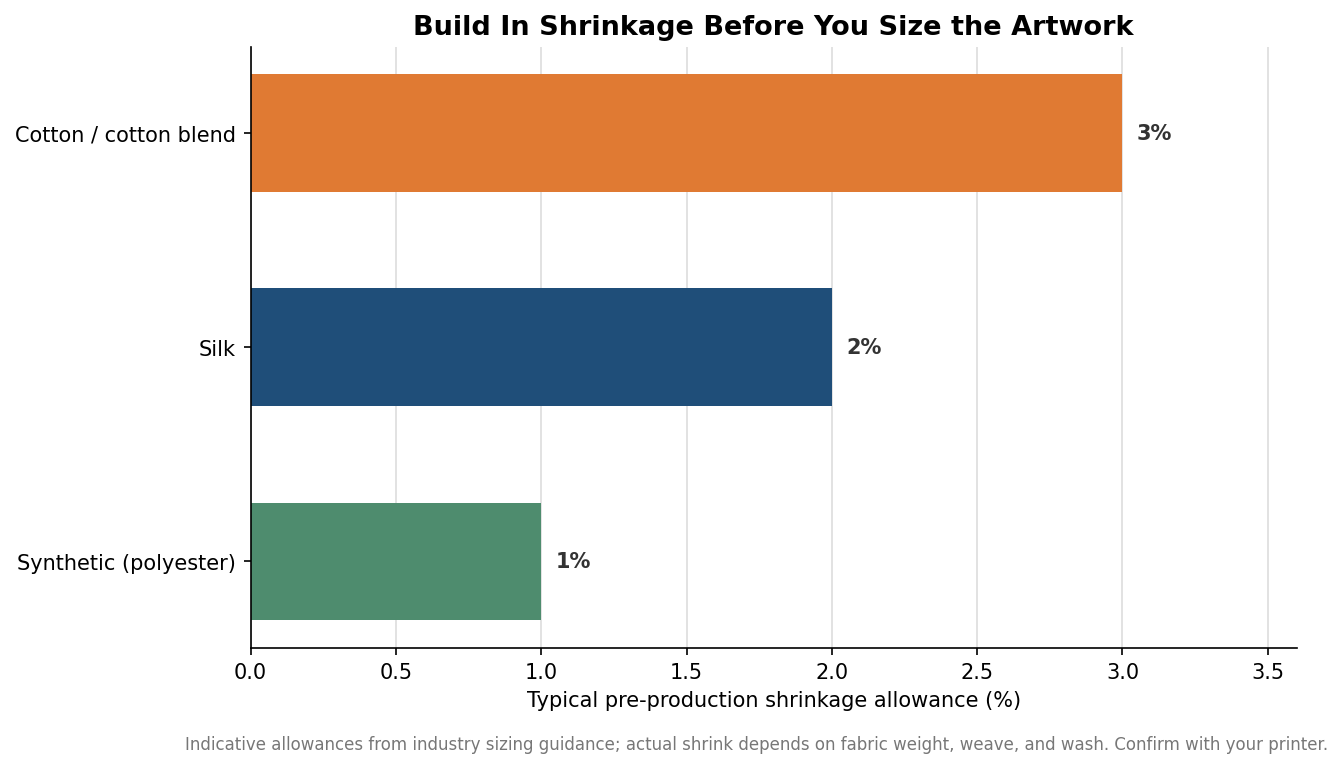
    Horizontal bar chart of typical pre-production shrinkage allowance by fabric: cotton 3 percent, silk 2 percent, synthetic 1 percent
    Cotton bandanas need the largest shrinkage allowance, which is another reason to keep artwork inside the safe margin.

    None of this replaces a physical or digital proof. Before a full run, confirm the print placement, the color build, and the position of any text relative to how the bandana will actually be folded and worn — a mark centered on a flat square can land awkwardly once the bandana is tied. Treat the proof as the last and most important checkpoint. Sizes and allowances here are indicative and vary by printer and fabric, so use them to plan the file, then let the approved proof confirm the result.
  • Bandana Fabric, Explained: Cotton, Polyester, and Blends for Custom Printing

    Bandana Fabric, Explained: Cotton, Polyester, and Blends for Custom Printing

    Every custom bandana decision eventually comes back to one question that gets asked too late: what is the fabric? People pick a size, settle on a print, approve a color, and only then discover that the cloth they chose fights the print method or feels wrong against the skin. Fabric is not a detail to confirm at the end. It sets how the ink sits, how the color survives washing, how the bandana feels around a neck or a dog’s collar, and how much a bulk run costs. This is a look under the hood at the materials themselves, so you can choose the cloth first and let everything else follow.

    The three families, and what separates them

    Almost every bandana is cut from one of three fabric families. Cotton is the classic: soft, breathable, gentle on skin, and hypoallergenic, which is why it dominates fashion and retail bandanas and anything worn against the face. Its weaknesses are practical rather than cosmetic. Cotton is prone to shrinking in high heat unless it has been pre-treated, it wrinkles easily, and as a raw material it costs more, which shows up in the per-unit price of a large order. Polyester is the opposite profile. It resists stretching and shrinking, holds up to repeated washing, and is generally cheaper to produce, which makes it the budget-friendly choice for big promotional runs. The catch is feel: polyester can seem less soft and can feel a little sticky against sweaty skin, so it wins on durability and loses on comfort. Poly-cotton blends exist to split that difference, pairing cotton’s hand with polyester’s resilience and lower cost.

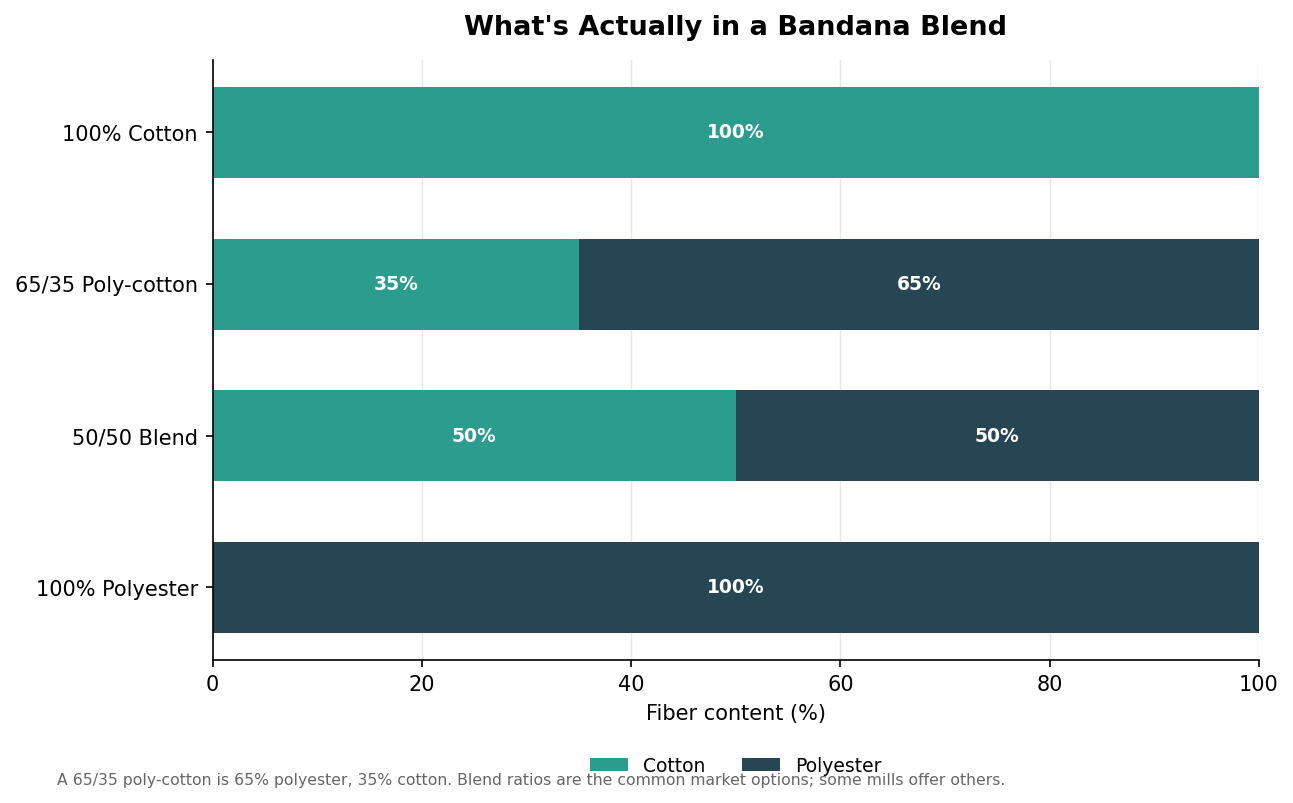
    Stacked bar chart showing cotton and polyester percentages in 100% cotton, 65/35, 50/50, and 100% polyester bandanas
    Blend labels list polyester first: a 65/35 poly-cotton is 65% polyester, 35% cotton.

    One point on that chart trips up a lot of first-time buyers. A “65/35 poly-cotton” is 65 percent polyester and 35 percent cotton, not the other way around; the polyester share is listed first. If you want a blend that leans toward cotton’s softness, you are looking for something closer to 50/50 or a cotton-majority mix, and it is worth stating the exact ratio you want rather than trusting a vague “cotton blend” label.

    Weave and weight change the character within cotton

    Cotton is not one thing. The weave decides whether a cotton bandana feels crisp and light or thick and rugged. Cotton poplin is smooth, lightweight, and tightly woven, which makes it a strong surface for detailed prints where fine lines and small text need to hold. Cotton twill uses a diagonal weave that is thicker, heavier, and more durable, trading some print sharpness for a substantial, hard-wearing feel. Fabric weight follows the same logic. Lighter bandanas, in the indicative range of roughly 100 to 130 grams per square meter, drape softly and tie easily, which suits neckwear and giveaways; heavier constructions climbing toward 150 to 180 grams per square meter feel more premium and survive rougher use, at the cost of a stiffer knot. Treat those weight figures as general guidance rather than a fixed standard, because mills vary, but the direction is dependable: lighter for drape and detail, heavier for durability and a premium hand.

    The print method should match the cloth

    This is where choosing fabric first pays off, because the two big print methods each prefer a different material. Screen printing lays opaque ink onto the surface and is at home on cotton, where the fiber accepts natural dyes and pigment inks well; it is excellent for bold, limited-color designs and holds up on a natural fabric. Dye sublimation works by turning dye into gas that bonds into polyester fiber, which means it needs polyester to work and rewards you with vivid, full-color, edge-to-edge designs and photographic detail that screen printing cannot easily match. The practical consequence is simple: if your artwork is one or two punchy colors and you want a natural cotton feel, screen printing on cotton is the natural pairing; if your design is full-color, gradient-heavy, or photographic, you are choosing polyester so sublimation can do its job. Trying to force a full-bleed rainbow onto cotton, or expecting a soft natural hand from a sublimated polyester, is how orders end up disappointing.

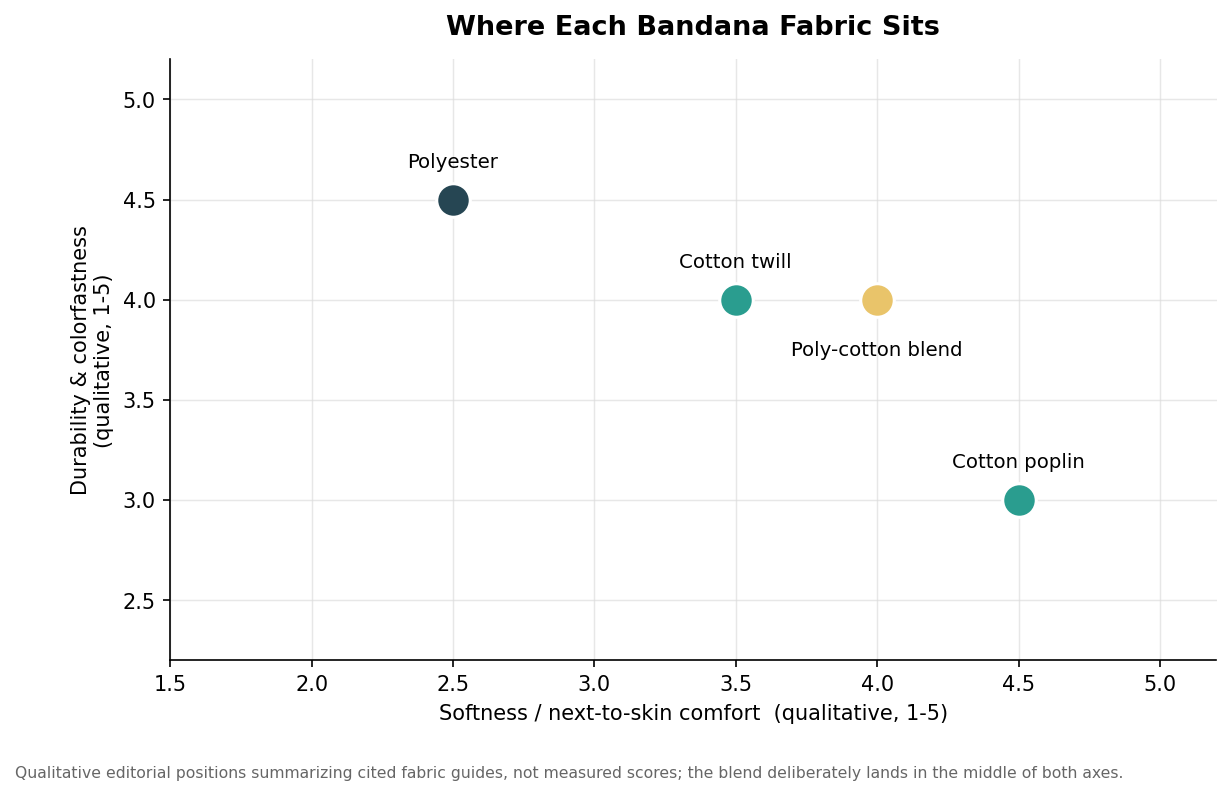
    Scatter positioning map of bandana fabrics by softness and durability, with poly-cotton blend in the middle
    Cotton leads on softness, polyester on durability and color, and the blend sits between.

    The positioning map above is a qualitative summary rather than a lab result, but it captures the trade every buyer is really making. Cotton poplin gives you the softest hand and the best canvas for fine screen prints while asking for care in the wash. Polyester anchors the durable, colorfast corner and pairs with sublimation for vivid graphics. The poly-cotton blend deliberately lands in the middle of both axes, which is exactly why it is the safe default when you cannot fully predict how a bandana will be used or laundered.

    The finish and the care label are part of the spec

    Two smaller fabric-linked details decide how a bandana ages. The edge finish is the first: a bandana can be left with a simple printed or overlocked edge for economy, or given a folded and stitched hem for a cleaner, longer-lasting border. A stitched hem resists fraying through repeated washing and reads as higher quality in the hand, which matters for retail and keepsake pieces more than for a one-day giveaway. The second is care behavior, which flows directly from the fabric choice. Cotton wants a cooler wash and benefits from pre-shrinking so it does not tighten up after the first laundering, while polyester and blends tolerate repeated washing with little change. If your bandanas will be washed often, as workwear or pet accessories are, that colorfastness and shrink resistance is a real argument for leaning toward polyester or a blend rather than pure cotton.

    Choosing the cloth, then the rest

    Put the material decision first and the order falls into place. Decide the feel and use: skin-contact comfort and a natural look point to cotton, heavy washing and vivid full-color graphics point to polyester, and an unpredictable mix of both points to a poly-cotton blend. Within cotton, pick poplin for fine prints and light drape or twill for a rugged, premium weight. Let that fabric choose the print method rather than the reverse, add a stitched hem where longevity matters, and set your care expectations to match the fiber. Do that, and the size, color, and artwork you settle on afterward will land on a cloth that actually supports them, instead of quietly working against the bandana you had in mind.

  • How to Choose the Right Custom Bandana for the Job: Dogs, Weddings, Teams, and Workwear

    How to Choose the Right Custom Bandana for the Job: Dogs, Weddings, Teams, and Workwear

    A bandana is a deceptively simple square of cloth that gets ordered for wildly different jobs: knotted on a dog at a Saturday market, handed out by the hundred at a 5K, tied around a groomsman’s neck, or stuffed in a work glove to keep grit out of a collar. The square looks the same in every case, but the right fabric, size and finish are not the same at all. If you have already sorted out sizes and print methods and just need to know which bandana fits which purpose, this is a selection guide organized by the job rather than by the spec sheet.

    Start with the job, then pick the bandana

    Three decisions do most of the work: the fabric, the finished size, and the print method, and the job dictates all three. Fabric ranges from smooth cotton poplin, which is lightweight and tightly woven for detailed prints, through heavier cotton twill with its durable diagonal weave, to polyester that holds dye so well that neons and bright reds stay vivid, and blends that split the difference. Finished size runs from small squares around eighteen to twenty-two inches up to the standard adult twenty-seven-inch bandana, with dog sizes measured differently again. Print method is the last lever: solid spot-color designs in bulk lean toward screen printing, while full-color or photographic artwork, especially on polyester, is the domain of digital and dye-sublimation printing. Get the job clear first and these three choices tend to resolve themselves.

    Dog bandanas: size to the neck, not the dog

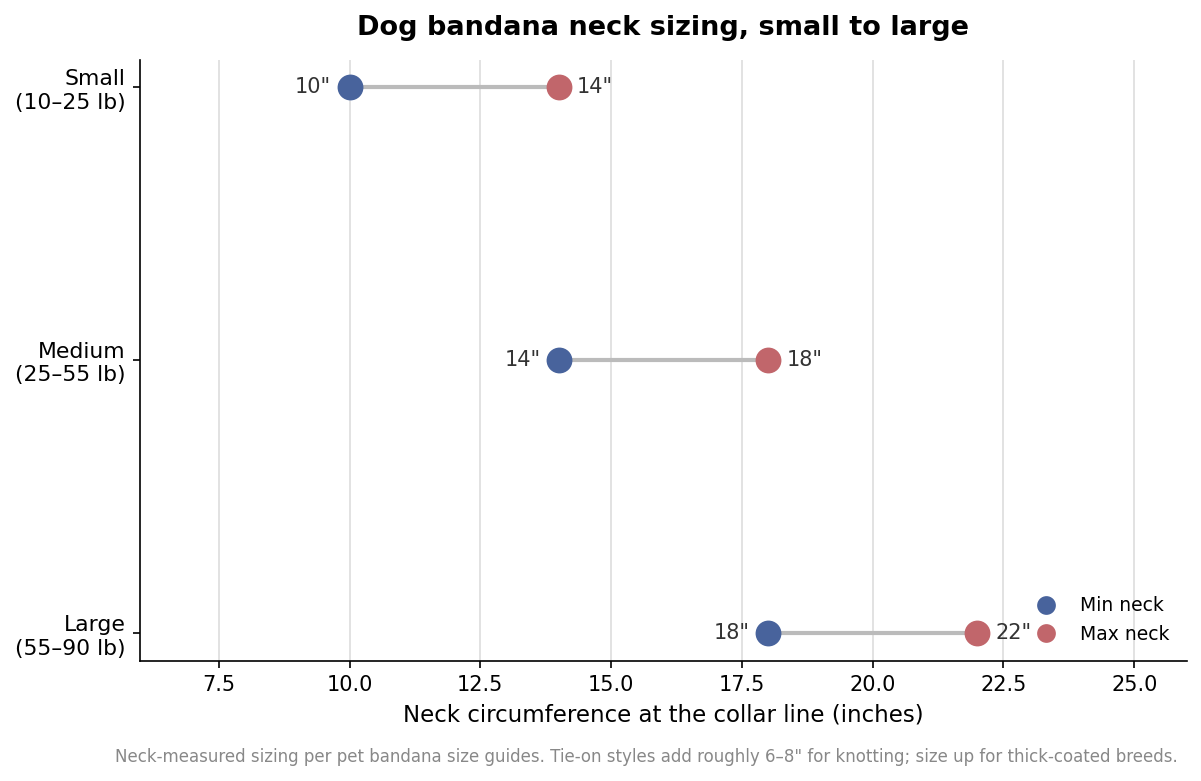
    Dog bandanas are the one use where standard human sizing fails you, because a dog is fitted by neck circumference rather than by a finished square. Measure around the thickest part of the neck where the collar sits, and apply the two-finger rule: if you cannot slide two fingers between the tape and the coat, it is too tight. As a working guide, a small dog of roughly ten to twenty-five pounds measures about ten to fourteen inches at the neck, a medium dog of twenty-five to fifty-five pounds runs fourteen to eighteen inches, and a large dog of fifty-five to ninety pounds falls between eighteen and twenty-two inches. Two construction styles follow from that measurement. A tie-on bandana needs the neck measurement plus roughly six to eight inches of extra fabric so there is enough to knot, while an over-the-collar style should cover only about half to two-thirds of the collar’s length so it does not block the leash clip. One caveat for the fluffy breeds: an eighteen-inch bandana can vanish into a thick coat, so size up when the fur is deep.

    Dot plot of dog bandana neck sizing showing min and max neck circumference in inches for small, medium and large dogs
    Fit a dog bandana by neck circumference; tie-on styles need another six to eight inches to knot.

    Weddings, parties, and favors: looks over toughness

    Event bandanas are seen at close range and rarely abused, so the priorities flip toward appearance and hand-feel rather than ruggedness. For weddings, welcome bags, and party favors, a soft cotton poplin takes fine detail beautifully and feels good against skin, which matters when guests actually wear the thing rather than pocket it. A smaller finished size around twenty-two inches reads as a tasteful accent and costs less than a full-size square, while the standard twenty-seven-inch bandana gives more room for an all-over pattern or a monogram. Because these runs prize crisp, often multi-color artwork and are usually modest in quantity, digital printing on a smooth cotton is frequently the natural fit. Durability barely enters the conversation; a favor that looks refined in a photo has done its job.

    Teams, fans, and promo giveaways: color and cost

    Giveaways live and die on bold color and unit price. When you are ordering in the hundreds or thousands for a game day, a race, or a trade-show table, polyester earns its place because it holds saturated dye so well that team reds and highlighter-bright promo colors stay punchy, and it costs less than cotton at volume. The trade-off is breathability and a slightly synthetic hand, which almost never matters for a spirit rag waved in the stands or knotted on a wrist. For a simple one or two color logo produced in quantity, screen printing keeps the per-piece cost down; when the design is full-color or photographic, dye-sublimation on polyester delivers edge-to-edge color that a screen cannot match. The guiding principle for promo is to spend on visual impact and quantity, not on a premium fabric nobody will scrutinize.

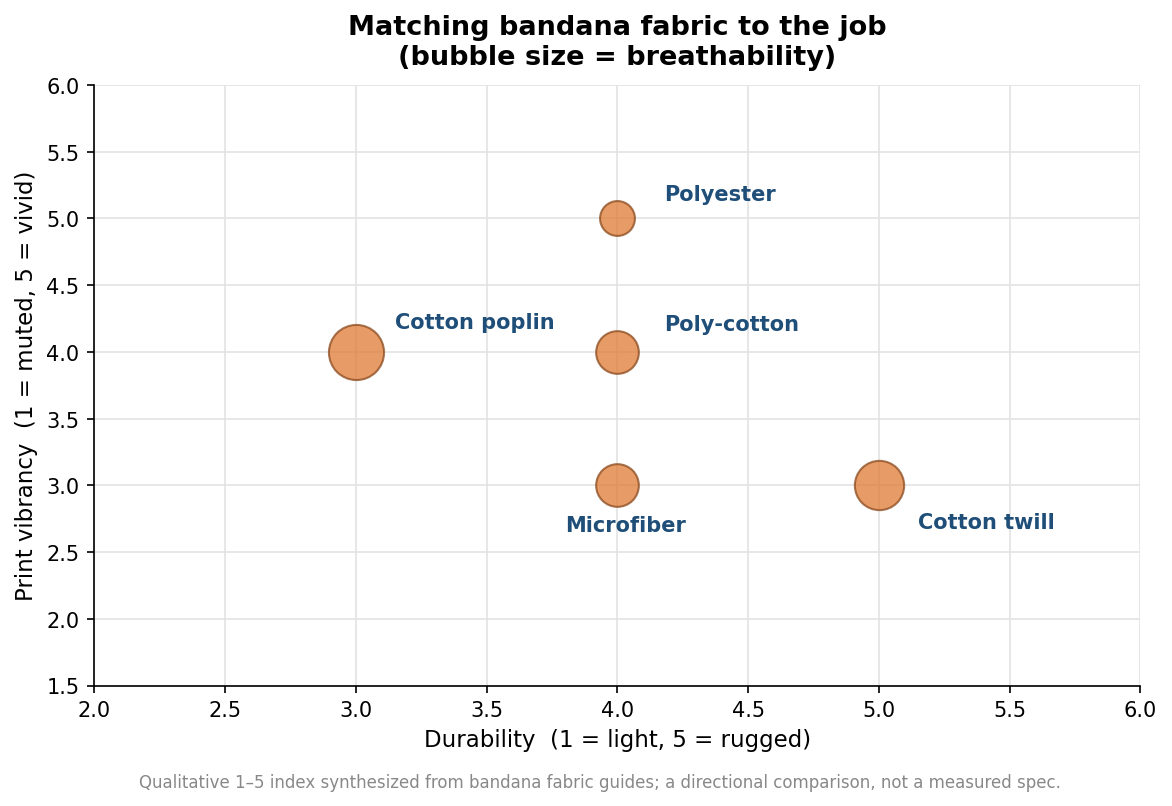
    Scatter chart mapping bandana fabrics by durability and print vibrancy with bubble size showing breathability
    Fabric picks its job: polyester for vivid promo color, twill for workwear, poplin for detailed event prints.

    Workwear and outdoors: fabric that earns its keep

    When the bandana has an actual function, fabric moves back to the front. For dusty jobs, farm and shop work, or anything where the cloth gets tied, soaked and wrung out repeatedly, cotton twill and cotton-poly blends hold up best; the twill’s tighter, heavier weave resists wear, and blends at fifty-fifty or sixty-five-thirty shrink less than pure cotton while staying reasonably soft. For running, hiking, and hot-weather sport, a microfiber or performance-poly bandana that wicks moisture and dries fast beats heavier cotton that stays wet against the skin. Retail and everyday-carry sit in the middle, where classic one-hundred-percent cotton remains the default for its breathability and familiar feel. Across all of these, decide how the piece will be laundered before you finalize the fabric, since a work rag that gets washed weekly has very different demands from a keepsake that gets folded in a drawer. Match the cloth to the abuse it will take, and the bandana quietly does exactly what it was bought to do.

  • Screen or Digital: Which Printing Method Your Bandana Needs

    Two printing methods cover nearly every bandana. They are not better and worse; they are suited to different artwork and different quantities.

    Screen printing

    Ink is pushed through a mesh, one screen per color. That gives a dense, saturated color that digital struggles to match, and the cost per piece falls sharply with quantity because the screens are the fixed cost.

    The limits are color count and detail. Every color needs its own screen, so beyond about six the economics stop working, and very fine gradients are not available at all.

    Digital printing

    The design is printed directly, so color count is irrelevant and photographic detail and gradients are all possible. Setup is minimal, which makes it the better choice at small quantities.

    Color reads slightly softer than screen on cotton. On most designs nobody notices; on a design built around one saturated brand color, some people do.

    Dye sublimation, for the technical squares

    Cooling bandanas are a synthetic knit, so they are dye sublimated: the color bonds inside the fiber, edge to edge, with unlimited colors and no hand feel at all. It is the best print in the range and it only works on synthetics.

    How to decide

    Flat-color design and a big run: screen. Photographic or many-colored artwork, or a small run: digital. Technical fabric: sublimation.

    Send us the artwork and the quantity and we will tell you which, including when the answer is the cheaper one.

  • Why Bandanas Outsell Shirts on a Merch Table

    Bands and event organizers who add bandanas to a merch table are usually surprised by how well they do. There are four unglamorous reasons.

    No sizing, no dead stock

    A shirt run means guessing a size curve, and every wrong guess is stock you carry for a year. A bandana is one size, so the entire order is sellable and the leftovers go straight onto the next date.

    That alone changes the risk profile of the table.

    The impulse price point

    It sits below the threshold where people stop to think, which means it sells to the crowd who would never queue for a shirt — and it sells as a second item to people who already bought one.

    It gets worn at the event

    A shirt bought at a show goes into a bag. A bandana goes onto a head immediately, and then several hundred people are wearing your artwork in front of everyone else for the rest of the night.

    No other merchandise item does that.

    Photographs well, travels flat

    It packs into almost no space, ships cheaply between dates, and shows up in the crowd photographs that end up online. Merchandise that is visible in the documentation of an event keeps working after it.

    How to run it properly

    Two designs, not six. One flat-color screen print at volume for the table, and, if the audience supports it, one tie-dye or embroidered run priced higher for the people who want something nobody else has.

    Order both together, and keep the artwork on file so a reorder mid-tour is a single email.

  • Bandana Sizes Explained: 22 Inch, 27 Inch and What Each One Ties

    Size is the first decision and the one most people skip, which is why so many bandanas end up in a drawer rather than on a head.

    22 inches: the classic

    The format the category is built on. It ties around a neck, a wrist, a bag strap or a dog comfortably, folds small, and is the cheapest square to produce at volume.

    Where it struggles is as a full head covering. It ties, but it pulls tight and sits high, and people who wear one all day notice within an hour.

    27 inches: the wearable

    Five extra inches turns the square into a garment. It ties as a proper head wrap, folds into a real neck scarf, and drapes over a shoulder. It is also considerably more comfortable to wear for a full shift.

    It costs more per piece and it is worth it whenever the bandana is bought deliberately rather than handed out.

    What size does to artwork

    At 22 inches, artwork competes with a knot and a fold almost immediately, so the design has to survive being seen in fragments. At 27 the pattern has room to read as a pattern, which is why retail pieces and paisley designs almost always want the larger square.

    A rule that works

    Handed out: 22. Bought, worn all day, or the pattern is the product: 27. If you are doing both — a giveaway square and a retail square — order them together and save a setup.

  • How to Specify a Custom Bandana Order: Size, Fabric, and Print Method

    How to Specify a Custom Bandana Order: Size, Fabric, and Print Method

    A custom bandana looks simple, but the order form hides four decisions that determine whether the finished piece feels like a keeper or a giveaway nobody keeps: the size, the fabric, the print method, and the quantity. Get those aligned and a bandana becomes a genuinely useful branded item. Get them wrong and you pay for 500 squares of fabric that pill after one wash or print muddy in the middle. Here is how to specify each one so the quote you get back matches what you actually want.

    Start with size, because it drives everything else

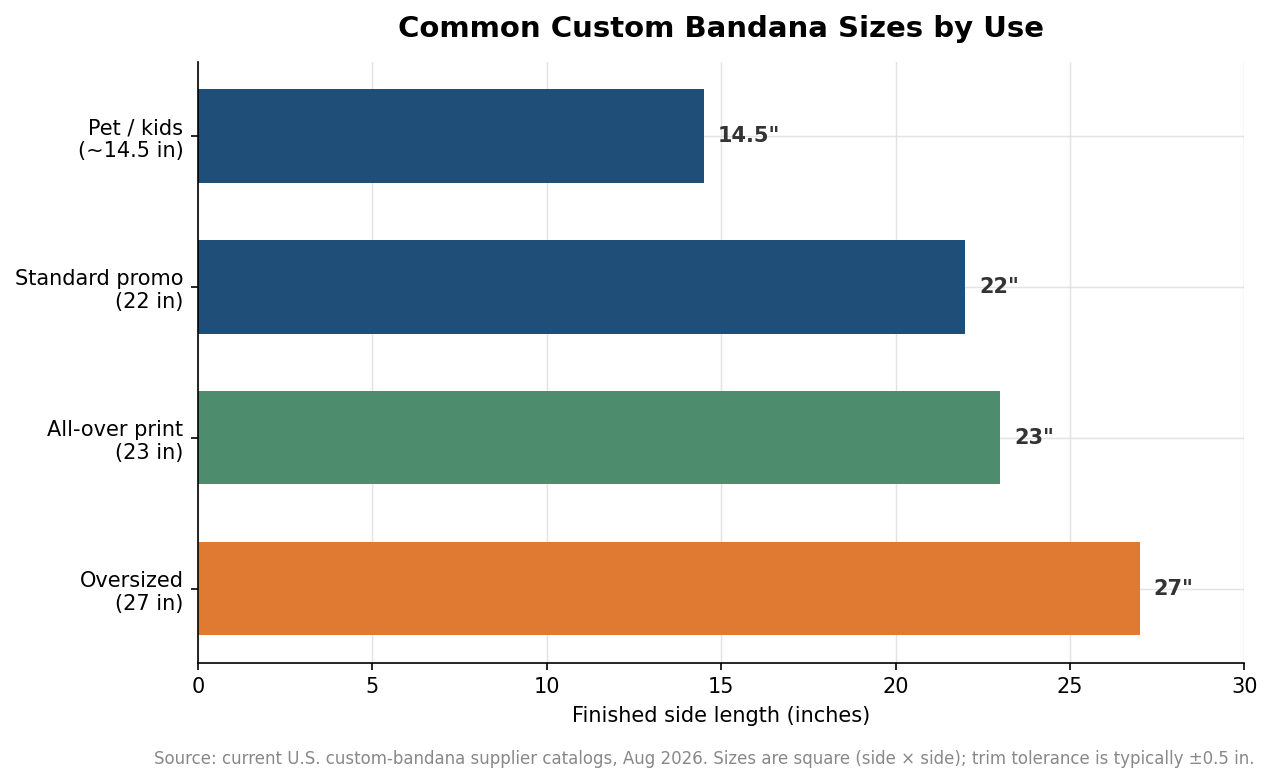
    Bandana size is measured as a square: the side length before hemming, so a “22-inch” bandana finishes at roughly 22 by 22 inches with a rolled or stitched edge taking a small amount off each side. Four sizes cover almost every order. The 22-inch square is the default promotional and fashion size, big enough to fold into a headband, face covering, or pocket square. The 27-inch is the oversized option people reach for when the bandana needs to work as a scarf, a dog-walking tie for a large breed, or a wall-hung piece. The 14 to 14.5-inch small square suits pets, children, and wrist ties. A dedicated 23-inch all-over size shows up specifically for edge-to-edge printed designs.

    Size interacts with print coverage, so decide it before you finalize artwork. A logo that reads well on a folded 22-inch bandana can disappear when the square is worn open, and an all-over pattern designed for 23 inches will crop awkwardly if you drop to 14.5. Expect a cut tolerance of about half an inch in either direction; that is normal for woven cotton and not a defect.

    Horizontal bar chart comparing common custom bandana sizes from 14.5 to 27 inches per side
    The four sizes that cover most custom bandana orders, by finished side length.

    Match the fabric to how the bandana will be used

    Fabric is where absorbency trades off against color. One hundred percent cotton is the traditional choice: soft, breathable, and absorbent, which matters if the bandana will actually be worn against skin or used to wipe sweat. Its trade-off is that cotton takes dye less vividly than synthetics and can shrink a few percent in the first hot wash, so build a little slack into any tight-fitting use. Cotton poplin is a crisper, tighter weave that holds a printed edge a bit more sharply while keeping most of cotton’s comfort.

    On the synthetic side, 100 percent polyester is the fabric to specify when color is the point. Polyester accepts dye-sublimation printing, which bonds the dye into the fiber for bright, edge-to-edge, wash-durable color that cotton cannot match. The cost is comfort and absorbency: poly feels slicker and wicks rather than soaks. Poly-cotton blends sit in the middle, giving you better color than pure cotton with more softness than pure poly. As a rule of thumb, choose cotton when the bandana is worn or wiped with, and polyester when a full-color graphic has to look saturated across the whole square.

    Pick the print method your artwork actually needs

    The print method follows directly from your design and fabric, not the other way around. Screen printing pushes ink through a mesh stencil, one screen per color. It is the workhorse for one, two, or three solid spot colors and gets cheaper per piece as the run grows, because the setup cost spreads across more units. It is a poor fit for photographs or gradients. Digital and direct-to-garment printing lay full-color artwork straight onto cotton with little setup, which is why many shops offer them with no minimum; the trade-off is a higher per-piece cost that does not fall as steeply with volume.

    Dye sublimation is the method for full-color, edge-to-edge designs, but it requires polyester fabric to work, so choosing it also chooses your material. Direct-to-film transfers are a newer option that handle detailed color on a range of fabrics. The practical takeaway: a two-color logo on cotton points to screen printing, a photographic or all-over pattern points to sublimation on poly, and a small full-color run with no minimum points to digital.

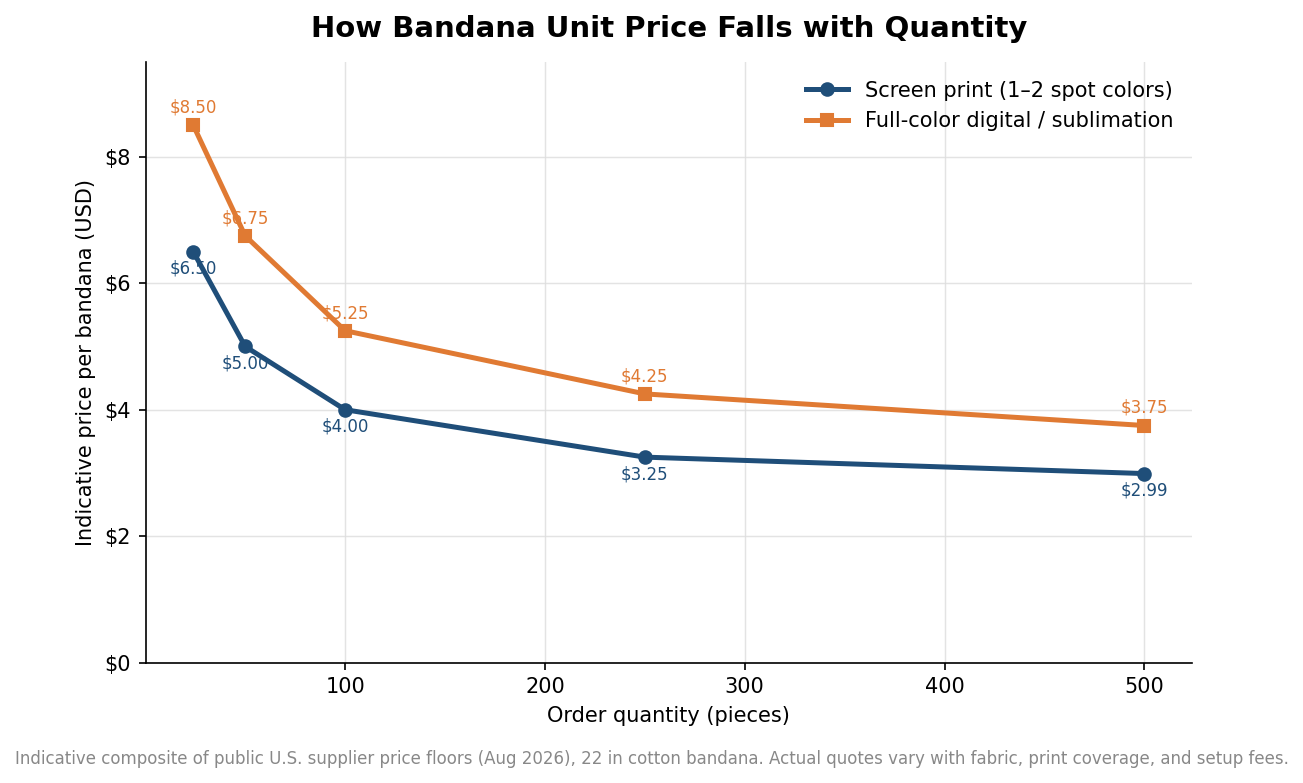
    Line chart showing indicative custom bandana unit price falling as order quantity rises, for screen print versus full-color printing
    Unit price drops with volume, and screen printing pulls ahead of full-color methods at higher quantities.

    Quantity, lead time, and getting the artwork right

    Minimum order quantities track the method. Digital and DTG printing frequently carry no minimum, which is what makes a run of a dozen feasible. Screen printing typically starts around six pieces because of the per-color setup, and all-over or sublimated printing often begins near twelve. Unit price falls meaningfully as quantity climbs: public supplier pricing for a standard cotton bandana commonly runs from the mid-single dollars at small quantities down toward roughly three dollars each in the hundreds, though the exact figure depends on size, print coverage, color count, and any setup fee. Treat those as indicative market ranges, not a quote.

    On timing, plan for production of about six to eight business days at faster shops and up to one to three weeks elsewhere once artwork is approved, with rush service sometimes available in three to four business days at added cost. Build in a day or two on top for a digital proof; approving one is the single easiest way to avoid an expensive reprint. Supply artwork as vector where possible, or at 300 dpi at final size, with your brand colors specified as Pantone references so spot-color screen printing matches across reorders. Add a small bleed for all-over designs and keep critical text away from the edges, since that half-inch cut tolerance will occasionally clip anything crowded into the margin.

    Specify those four things clearly, in that order, and the rest of the order tends to fall into place. Size sets the canvas, fabric sets the feel and color ceiling, print method follows the artwork, and quantity sets the price. A supplier can quote confidently from that, and the bandanas that show up will look like what you pictured.